

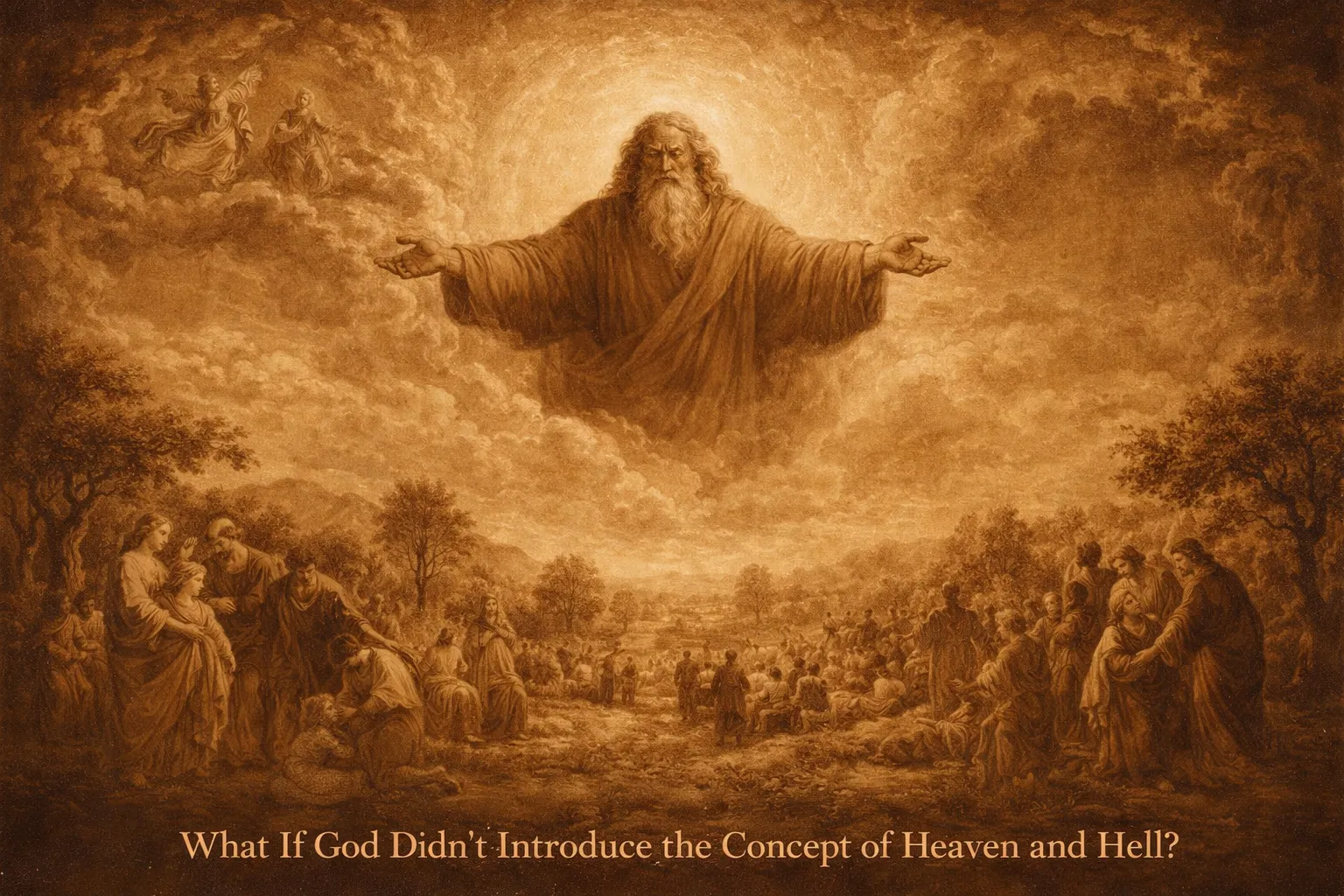
Picture a world in which the gates of Paradise never glittered in your mind, and the fires of damnation never kept you awake at 2 a.m. after a childhood sermon. No pearly gates. No lake of fire. No ledger-keeping angel. No eternal reward for your charity, and no eternal punishment for your envy.
Just this life, raw, finite, and unrepeatable. The question isn’t hypothetical navel-gazing. It’s perhaps the most consequential theological question of our age: Would humanity be more moral, more free, or more lost without the concept of Heaven and Hell?
The debate is not new. Scholars, theologians, atheists, and ordinary believers have wrestled with it for centuries. But it has never been more urgent. In an era when religious institutions are losing credibility, when algorithmic dopamine has replaced divine judgment as the enforcer of human behavior, and when millions quietly exit organized faith, this question demands a real answer.
And the answer, I will argue, is both more sobering and more liberating than either the faithful or the skeptics are willing to admit.
The Uncomfortable Origin Story of Heaven and Hell
Before we speculate about a world without these concepts, we must be brutally honest about how they arrived. The concepts of Heaven and Hell as we understand them today are not ancient.
Biblical scholar Bart Ehrman, in his extensive work on afterlife theology, has noted that the sharp focus on individual salvation, Heaven, and Hell in the way Christianity frames it is largely a product of the last two millennia, and not a feature of the earliest religious instincts of the human species.
For the vast majority of human existence, religion served no afterlife function. People were religious for entirely different reasons: to explain thunder, to ensure rain, to honor ancestors, to bind communities. The “what happens after I die” machinery was bolted on much later, and in Christianity and Islam, it became load-bearing architecture.
- 74% of Americans believe in Heaven (Pew Forum)
- 58% believe in Hell (Pew Forum)
- 200K+ years of human religion before a strong afterlife focus emerged
This matters enormously. It tells us that Heaven and Hell were not foundational to humanity’s spiritual impulse; they were an upgrade. Or, depending on your view, a patch. And patches can sometimes cause more problems than the bugs they fix.
Heaven and Hell as a Moral Control System
Let’s be direct. The most intellectually honest reading of how Heaven and Hell functioned historically is as a moral control mechanism, a carrot-and-stick system of cosmic governance. Obey, and you earn eternal bliss. Transgress, and you earn eternal torture.
The brilliance of this system, from a sociological standpoint, is staggering. No earthly court can surveil every dark thought. No king can peer into private sin. But an omniscient God can, and Hell was the penalty clause that made the entire contract enforceable.
In the past, heaven and hell were both invented as a way of making sure people behaved in a certain way. It was sort of a ‘carrot and stick’ approach to luring people into following the religion; they were too scared to disobey in fear of spending an eternity in Hell.
This is not a fringe reading. It is the common-sense interpretation shared by millions of secular thinkers, ex-believers, and even some progressive theologians. But here’s where the opinion gets complicated: does that make Heaven and Hell wrong?
A control system can be unjust and yet effective. And effectiveness has historically been no small thing when civilizations were young and fragile.
What Happens When You Remove the Stick?
Here is the central thrust of my argument: removing the concept of Hell would have made morality more authentic and more fragile, simultaneously.
Consider what drives moral behavior in a world without divine judgment. Empathy? Yes, but empathy is partial and inconsistent. Social reputation? Yes, but reputation can be managed and faked. Law? Yes, but the law only reaches so far.
The concept of Hell plugged a gap that human psychology and social systems genuinely struggled to fill. The person who commits a private sin, who steals when no one is watching, who lies to cover a crime, who harbors hatred in the heart, has no earthly reckoning to fear. Hell was the surveillance camera that never went offline.
Without it, would people behave better, motivated by pure virtue? Or worse, freed from cosmic accountability? The evidence from secular societies is genuinely mixed. Scandinavian nations consistently rank among the least religious and most ethical globally. But they inherited centuries of Christian moral infrastructure before secularizing. The scaffolding was removed after the building was already standing.
Without the worries of going to hell, or what heaven is like, or how will I please God, we can be free. I believe we could all be further united without religion and its afterlife promises.
– Atheist contributor, public debate forum
If there is no afterlife, there is absolutely no reason to be religious, at least that’s what my students think. But for the vast majority of the human race historically, the afterlife was not part of religion at all.
– Bart Ehrman, New Testament scholar, commenting on student perspectives
The idea of not having an afterlife would be difficult for Christianity to survive. The early Middle Ages peasants lived in unbelievable conditions, with the church agreeing their existence was horrible — but their reward would be in heaven. Christianity provides the hope of something better to come, and without that future promise, Christianity would not survive.
— Commenter, The Bart Ehrman Blog
I simply cannot accept the concept of a God that would torture people for eternity. While I believe there is some kind of afterlife, a hell of eternal torment is an insane cruelty that I wouldn’t wish on anyone. If I wouldn’t wish it on anyone, how could a loving God?
— Debate contributor, Debate.org thread on Heaven & Hell
Religion is just another ideology and would soon find replacement by some other ‘-ism’. Abolishment of religious concepts would not confirm causation leading to a world of better morality or potential. Human nature fills the void.
— Forum commenter, Debate.org “World Without God” thread
The Philosophical Problem God’s Silence Would Have Solved
Here is something the defenders of Heaven and Hell rarely confront: the very existence of Hell creates what philosophers call the “Problem of Hell.” If God is omniscient, God knows before creating any soul whether that soul will end up in Hell. If God is omnipotent, God could have simply not created those souls, or created them differently.
And if God is omnibenevolent — supremely loving — why would such a God design a system where infinite punishment answers finite transgression?
Philosopher Immanuel Kant grappled with this directly. He argued that because human morality ultimately rests on disposition and maxim — on the orientation of the will — every person is in some sense infinitely guilty of violating the moral law, and therefore infinite punishment is not entirely unjustified.
But this is cold comfort. It is the philosophical equivalent of saying every child deserves to be expelled because all children break rules. Modern Muslim thinkers like Edip Yüksel have argued that Hell, if it exists, must be finite — a period of just purification, not an eternity of torment.
The Quran’s descriptions of both paradise and punishment, they argue, are balanced and proportional — not the medieval Christian caricature of eternal fire.
It’s a mistake to think you can even talk about God in the Western tradition without talking about heaven. The question of salvation is central to Judaism, Islam, and Christianity.
— Lisa Miller, author of Heaven: Our Enduring Fascination with the Afterlife
And this is the crux. Heaven and Hell did not emerge as peripheral doctrines — they became load-bearing walls. Remove them and the entire edifice of Abrahamic salvation theology buckles. This tells us something profound: if God had chosen not to reveal these concepts, He would have been offering not just a different afterlife, but an entirely different relationship between humanity and the divine.
Would Morality Survive Without the Afterlife Promise?
My honest, perhaps uncomfortable, opinion: morality would survive, but it would look radically different.
Religion without the afterlife is not a modern invention. Buddhism, in its classical form, is a non-theistic tradition focused entirely on liberation from suffering in this existence. The Jehovah’s Witnesses, as one forum commenter from a religious background noted, teach that there is no Hell, that sinners simply cease to exist.
And many Indigenous religious traditions across the globe built elaborate ethical systems around ancestor reverence, community harmony, and natural law with no celestial courtroom in sight. The evidence suggests that humans are capable of moral reasoning without the threat of Hell.
But capability is not the same as habit. When the motivational structure is removed, many people, particularly those whose morality was entirely outsourced to divine reward and punishment, would be left without an engine. Not because they are bad people, but because they were never taught to build one.
What Would Religion Actually Look Like?
Without Heaven and Hell, religion would likely become far more focused on the present: on community, on ritual, on meaning-making in the face of death, on ethical living for its own sake. This is arguably a more mature form of faith.
Theologian Rob Bell famously challenged his evangelical tradition with the notion that Jesus’ ultimate message was about love, not about avoiding Hell. “Jesus didn’t come along and say, ‘You don’t want to be a part of that thing, do you?'” Bell argued. “He came along and said, ‘Trust me. Something big is going down.'”
Without the Hell-fire sermon, perhaps more people would trust. And perhaps fewer would attend church primarily out of existential terror.
The Liberating Possibility and Its Dark Shadow
There is a genuinely beautiful world imaginable here: one where people do good not because they fear damnation, but because goodness is worth doing. Where compassion is not a down payment on Heaven but a full expression of humanity. Where faith is about wonder rather than insurance.
But I will not be dishonest about the shadow that trails this vision. Human history is littered with the wreckage of moral systems that removed transcendent accountability. When ideology replaces theology as the source of ultimate judgment, the results are not always more humane.
The 20th century’s most murderous regimes were explicitly secular. Their crimes were not committed because of atheism, but the absence of an eternal moral anchor did not prevent them either.
The honest conclusion is this: the concept of Heaven and Hell, whatever its origins, encoded something humanity desperately needed, the idea that actions have consequences beyond the visible. The question is not whether that idea is useful.
It clearly was and is. The question is whether it had to be packaged in the specific, terrifying, exclusionary way that it was in much of Western religious history.
A World Without Heaven and Hell Would Be Freer, and Far Less Certain
If God had never introduced the concept of Heaven and Hell, humanity would have inherited a religion of the present: richer in empathy, lighter in fear, and far more uncertain about why to be good. The moral architecture of civilization would have had to be built from scratch, from community, from reason, from love, without the cosmic guarantee that justice would ultimately prevail.
That is, in many ways, exactly the world secular modernity is now building. And the jury, across faiths, philosophies, and Reddit threads at 2 a.m., is still very much out on whether we are pulling it off.
Perhaps the real question God’s silence would have forced upon us is the one we have always been afraid to answer for ourselves: is virtue worth anything if no one — not even God — is watching?
People Also Ask
Yes, but differently. Research on secular societies shows that morality rooted in empathy, social norms, and legal frameworks can function without afterlife beliefs. However, historians note that most modern secular nations inherited centuries of religiously shaped moral infrastructure before secularizing, which means the moral habits were already embedded culturally before the theological justification was removed.
No. Biblical scholars like Bart Ehrman point out that for the vast majority of human religious history, possibly 198,000 of 200,000 years, religion had little to no strong afterlife focus. The sharp Heaven-and-Hell framework became central to Christianity and Islam relatively recently in historical terms. Many of the earliest religious traditions focused on ancestral reverence, community ritual, and natural harmony.
Known as the “Problem of Hell,” the core tension is this: if God is all-knowing, all-powerful, and all-loving, why would He design a system where finite sins result in infinite punishment? Philosophers like Kant wrestled with this, and modern theologians across Christianity and Islam have proposed alternatives, from annihilationism (sinners simply cease to exist) to universalism (all souls are eventually reconciled with God).
Heaven and Hell effectively solved a surveillance problem that no earthly institution could: they made private sin visible to an omniscient judge. Where laws and social reputation fail, in the privacy of thought, hidden action, and personal transgression, the promise of divine reward and punishment extended moral accountability into spaces no human authority could reach.
It would likely resemble many existing traditions that de-emphasize the afterlife: Buddhist focus on present liberation, some strands of Judaism that are largely agnostic about the afterlife, Unitarian Universalism, and many Indigenous spiritual systems. Religion without afterlife reward and punishment tends to center on community cohesion, present-moment ethics, ritual meaning-making, and relationship with nature or the divine, rather than personal eternal salvation.